

As online trading continues to gain popularity among various groups of people, Muslims are now beginning to ask an important question: “Is forex trading halal or haram in Islam?” Even though foreign exchange trading involves flexibility and allows traders worldwide to access global financial markets wherever they are, Islamic finance involves more than just financial benefits.
Furthermore, this guide provides an insight into the Islamic perspective of forex trade, including opinions of scholars and the reality of profit, along with the legality of forex trade in the UK, so that Muslim traders can make their decisions wisely.
Understanding Forex Trading in Islam
Trading on the foreign exchange market takes the form of buying one currency as well as simultaneously selling another, usually with the purpose of profiting from exchange rates. In Islam, the exchange of currencies by Muslims on their own is not banned. Trading with money has been practiced since the earliest times of trade.
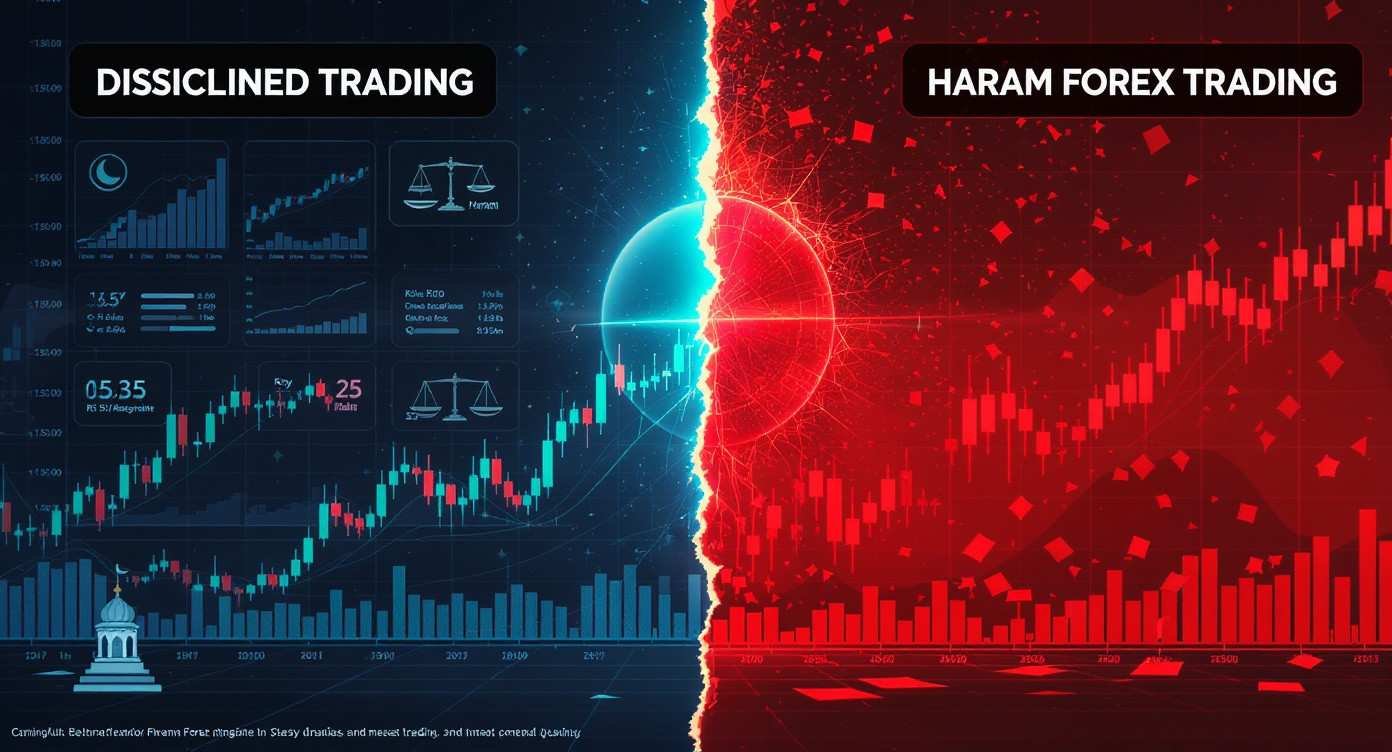
“The actual issue is not what is being exchanged; it is how it is exchanged.” Indeed, with the advent of forex markets as practiced by today’s world globalization and commerce systems and models, there are elements within that may clash with orthodox Islamic principles on:
- Ribā (interest)
- Gharar (excessive uncertainty)
- Maisir (gambling or speculation)
These elements determine whether forex trading is permissible or prohibited.
Scholarly Views: Is Forex Trading Permissible?
There is no unanimous view of Islamic scholarship on forex trading. In fact, Islamic scholars’ opinions on forex trading may largely depend on whether it involves an Islamic trading account or not.
Interest (Swap Fees) and Ribā
In most traditional forex accounts, the overnight swap or rollover fees apply. These fees are interest charges. Earned and paid interest in any form is strictly prohibited in Islam. When a trader is dealing in forex, and interest is a part of the activity, the activity is considered haram.
In response to this challenge, it has become common practice for brokers to open Islamic or ‘swap-free’ forex accounts, where all fees related to interest are abolished. Brokers then generate profit in terms of fees or as service charges. Others still agree to this arrangement as long as it does not amount to payment of interest.
Immediate Exchange and Settlement
Under Islamic law, when money changes hands, the ownership transfer must occur instantly. In the contemporary system, the trades happen electronically, and this takes only seconds.
However, some scholars view this immediate electronic execution as intended to constitute a form of constructive possession, hence valid. On the other hand, others say that the delay in settlement renders the transaction dubious due to the uncertainty created.
Is Forex Trading Gambling?
One of the most serious complaints that exists against the foreign exchange market is that it’s similar to gambling. This problem is real—but only if the following conditions are met.
- If a trade is carried out impatiently without analysis, planning, and control of risks, then this is essentially gambling, which is completely banned under Islam.
- As the activity of trading is the result of research, market analysis, and sound risk management, traders consider it a legitimate business activity and not a game of chance, according to many scholars.
In Islam, intention and approach count. To gamble in forex, even in an Islamic account, can make such a venture unacceptable from a spiritual/ethical standpoint.
Leverage and Margin Trading: A Grey Area
The leverage can enable traders to hold bigger positions with relatively small capital. This will also mean that while there is a potential for profits to be hugely increased, the dangers of risking phenomenal losses are also very real.
Islamic scholars differ on leverage:
- Indirect borrowing in margin trading favors the broker and should therefore arouse Sharia concerns.
- Others allow for leverage, provided there is no interest charged, terms are transparent, and risks are managed in a responsible way.
A very high level of leverage is sure to lead to wild, emotional decision-making and huge losses, all of which, again, are contradictory to Islamic values of moderation and responsibility.
So, Is Forex Trading Halal or Haram?
There is no absolute yes or no answer.
Forex trading may be considered halal if:
- A genuine Islamic (swap-free) account is used
- No interest is paid or earned
- Trades are based on knowledge and analysis
- Gambling behavior and reckless speculation are avoided
Forex trading becomes haram if:
- Interest is involved
- Trading is driven by greed or blind speculation
- Risk management and ethical considerations are ignored
Any claim that forex trading is always halal—or always haram—oversimplifies a complex issue.
Can Forex Trading Really Be Profitable?
Forex trading has the potential to be profitable, but the reality is harsh: most traders lose money. This is not because the market is fraudulent, but because many participants lack discipline, education, and emotional control.
Sustainable profitability requires:
- Long-term learning
- Patience and consistency
- Strong risk management
- Realistic expectations
From an Islamic standpoint, chasing quick riches can foster greed and impatience—traits that Islam actively discourages. Even halal trading practices can become spiritually harmful if driven by unhealthy intentions. Forex should be viewed as a skill-based profession, not a shortcut to wealth.
Is Forex Trading Legal in the UK?
Yes, forex trading is legal in the UK. Brokers offering forex services must be regulated by the Financial Conduct Authority (FCA), which provides oversight and consumer protection.
However, legal does not mean halal. A trading activity may fully comply with UK law while still violating Islamic principles. Muslim traders must ensure their trading practices align with both UK regulations and Sharia requirements.
Forex Trading for Muslims Living in the UK
Muslims in the UK have access to regulated brokers and Islamic trading accounts, leaving little excuse for ignorance.
However, responsibility remains on the trader to:
- Verify that the Islamic account is genuine
- Understand the fee structure
- Avoid blindly copying trades or following social media signals
- Maintain ethical discipline and intention
Trading motivated by greed or imitation undermines any claim of Sharia compliance.
Final Thoughts
Trading forex can neither be labeled halal nor haram; this all depends upon the particular circumstances surrounding the trade. If education and proper self-control are not employed correctly, forex trading may very well result in unethical practices, even when performed using an interest-free account.
Conversely, when forex trades are performed with the proper know-how, exemplary self-control, sound intentions, along the adoption of proper Islamic account options, this type of trade might justifiably be labeled halal or, at the very least, profitable. The fact remains that most traders who experience defeat when participating in forex may not necessarily be losing due to Islamic restrictions, but rather their very own actions.
FAQs
Is forex trading halal in Islam?
Forex trading is not automatically halal or haram. Its permissibility depends on whether it involves interest, gambling, or unethical speculation.
Is forex trading halal for beginners?
Beginners face a higher risk of turning trading into gambling due to a lack of experience. Without education and discipline, forex trading can easily become haram.
Is forex trading profitable long-term?
Yes, but only for disciplined traders. Most losses result from poor risk management and unrealistic expectations.
Is forex trading legal in the UK?
Yes. Forex trading is legal when conducted through FCA-regulated brokers. However, legality does not guarantee Sharia compliance.
Do Islamic forex accounts make trading halal?
Islamic accounts remove interest, which is a major requirement. However, traders must still avoid gambling, excessive speculation, and unethical behavior.